
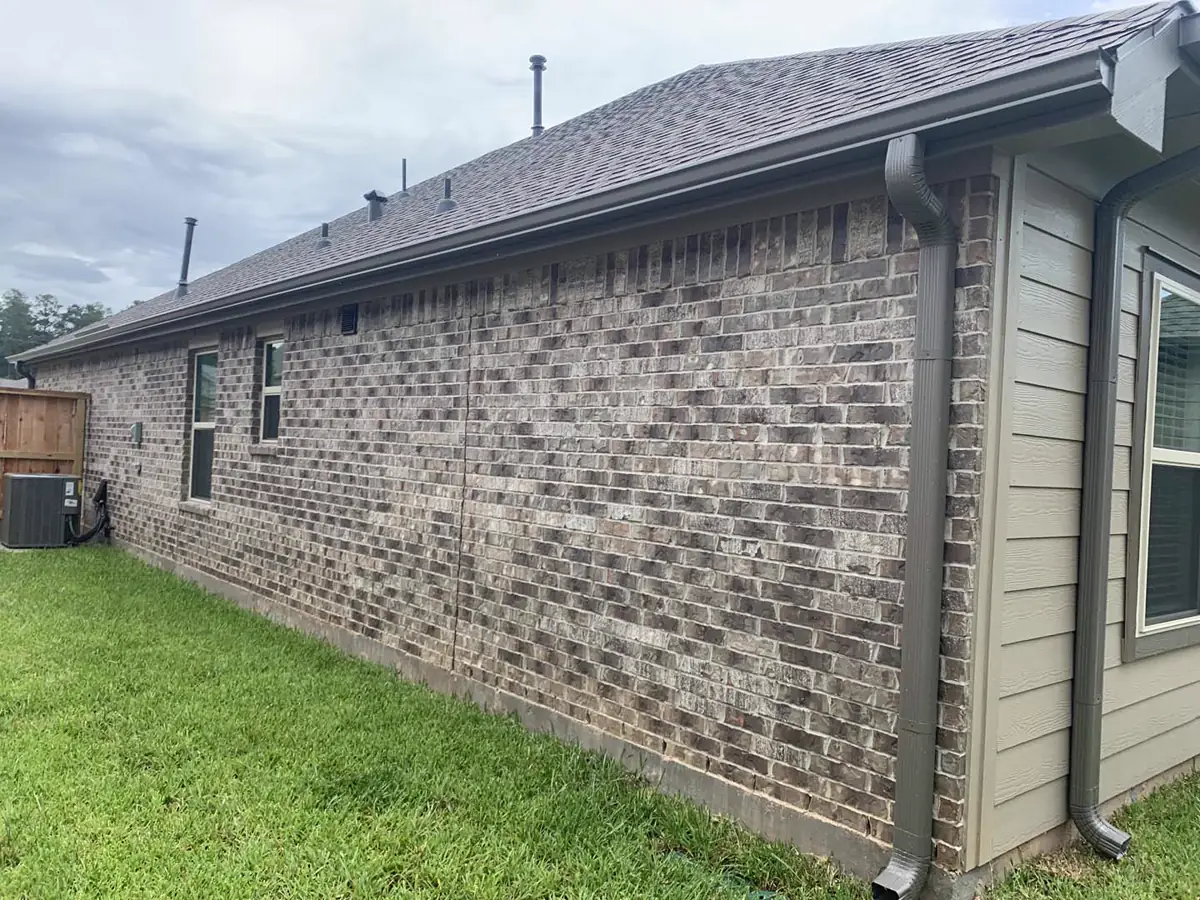
Gutter and Downspout Sizing
Download PDFGutter and Downspout Sizing Principles in Residential Applications
Abstract
This paper examines the functional criteria influencing seamless gutter and downspout sizing in residential construction across the United States. By evaluating regional rainfall intensity, severe weather exposure, roof catchment area, and market constraints, this document identifies practical and performance-oriented guidelines for residential gutter system sizing. While product availability and economic pressures affect final installation decisions, consistent proportional relationships emerge that inform rational sizing standards.Introduction
Seamless aluminum gutter systems are commonly stocked in nominal 5", 6", and less frequently 7" sizes. Downspouts are typically available in 2"×3", 3"×4", and occasionally 4"×5" configurations, depending on regional supply chains. It is critical to distinguish between profile shape and functional size. Profile refers to the aesthetic and geometric form of the gutter or downspout (e.g., fluted, smooth box, round, K-style, straight-face). Size refers to functional water-carrying capacity, determined primarily by:- The top width and cross-sectional area of the gutter (Fig.1)
- The largest interior dimension of the downspout (Fig.2)
- 3" Downspout - Any style whose largest dimension measures approximately 3" (e.g., 2"×3", 3" round, 3"×3" box)
- 4" Downspout - Any style whose largest dimension measures approximately 4" (e.g., 3"×4", 4" round, 4"×4" box)
- 5" Downspout - Any style whose largest dimension measures approximately 5" (e.g., 4"×5", 5" round, 5"×5" box)
Approximate Water Volume by Nominal Gutter Size
(Values represent rough averages and do not account for minor variations in profile geometry.)Nominal Gutter Size Gallons per Linear Foot (Approx.)
5" ~1.0 gallon
6" ~1.7 gallons
7" ~2.3 gallons
The increase in capacity is non-linear; nominal upsizing represents a substantial hydraulic gain.1. Identification of Distinct Climate Regions in the United States
For gutter sizing purposes, the United States may be broadly categorized into functional rainfall regions:- Arid / Semi-Arid (Southwest, Intermountain West)
- Moderate Rainfall (Midwest, portions of the Northeast)
- High Rainfall (Southeast, Pacific Northwest)
- Coastal Hurricane-Prone (Gulf Coast, Atlantic Coast)
- Snow-Dominant (Upper Midwest, Northern Plains, Mountain West)
2. Rainfall Totals and Intensity Considerations
Regional rainfall data reveal distinct performance demands:- The Southeast experiences both high annual rainfall and high-intensity storm events.
- The Pacific Northwest sees high annual totals but often with lower peak intensities.
- Arid regions receive low annual totals yet may experience sudden high-volume monsoon events.
- Peak rainfall rate
- Roof surface area contributing to each gutter run
3. Severe Weather Considerations
Regional stressors extend beyond simple water volume.Snow-Dominant Regions
- Ice accumulation reduces effective gutter capacity.
- Snow and ice slide can deform undersized systems.
- Larger nominal sizes provide both structural rigidity and volume buffer.
Hurricane / Coastal Regions
- Wind-driven rain increases instantaneous water entry rate.
- Tropical systems produce extreme short-term loads.
- Upsizing reduces overflow risk during rare but high-impact events.
4. The Role of Roof Size
Roof catchment area is a primary determinant of drainage demand. Critical variables include:- Total roof square footage
- Length of gutter runs
- Number of roof planes draining into a single run
- Valley concentration points
- Increasing gutter size
- Increasing downspout quantity
- Or implementing both adjustments
5. Relational Sizing Between Gutter and Downspout
A consistent proportional relationship is observed across most residential markets: Nominal Gutter Size - 2 inches ≈ Downspout Size Examples:- 5" gutter → 3" downspout
- 6" gutter → 4" downspout
- 7" gutter → 5" downspout
6. Outlet Size
The outlet serves as the transition between horizontal collection and vertical discharge. An outlet smaller than the downspout restricts effective capacity regardless of pipe size below. Best practice suggests that the outlet opening should approximate the full interior dimension of the downspout as closely as available products allow, minimizing constriction at the transition point. The following values represent approximate theoretical discharge capacity under ideal vertical flow conditions. Actual performance varies drastically based on vertical drop, friction loss, downspout fittings, system slope and volume compared to capacity of the gutter system. Evacuation speed of outlets in Gallons per Min (Approx.)3" ~220 gallon
4" ~390 gallons
5" ~612 gallons
7. Roof Material and Slope
Roof surface characteristics significantly affect gutter performance. Smooth metal roofs and steep-pitched shingle roofs generate faster-moving water with increased splash velocity at the eave line. In such conditions:- Water may overshoot narrower gutters.
- Additional nominal width improves capture efficiency.
8. Downspout Location Relative to Water Load
Downspout placement materially affects system performance. Key field-based guidelines include:- Valley discharge areas should be supported by nearby downspouts.
- Concentrated valley discharge restricts lateral flow around inside corners; dead-end runs exceeding approximately 10 feet from an inside corner should be avoided without a downspout.
- Gutter runs exceeding 40 feet should avoid single-terminal discharge when feasible.
- 5" systems should target approximately 25 feet of gutter per downspout.
- 6" systems may reasonably extend to 35 feet per downspout under moderate rainfall conditions.
Real-World Hydraulic Comparison
To illustrate the practical implications of rainfall intensity on nominal gutter sizing, consider two representative storm scenarios. These examples assume:- A 25' × 25' roof section (625 sq ft catchment area)
- Even distribution into a single 25-foot gutter run
- No slope inefficiencies or friction losses (idealized condition)
Scenario 1: High-Intensity Storm in East Texas
Observed peak rainfall intensity:0.04 inches per minute
Step 1: Water Volume Generated
625 sq ft roof area × 0.04 inches per minute ≈ 19 gallons per minuteStep 2: Gutter Storage Capacity (25-foot run)
- 5" gutter (~1 gallon per foot)
- → ~25 gallons total capacity
- 6" gutter (~1.7 gallons per foot)
- → ~42 gallons total capacity
Performance Interpretation
Under these conditions:- A 5" gutter approaches full capacity in little more than one minute of sustained peak rainfall.
- This leaves minimal tolerance for:
- Valley concentration
- Inside corners restricting lateral flow
- Splash velocity
- Minor debris accumulation
- A 6" gutter provides approximately 42 gallons of holding capacity - more than a 50% increase over the 5" system - creating meaningful hydraulic margin.
Scenario 2: Tropical Storm Conditions in Florida
Observed peak rainfall intensity:0.10 inches per minute
Step 1: Water Volume Generated
625 sq ft roof area × 0.10 inches per minute ≈ 39 gallons per minuteStep 2: Gutter Storage Capacity (25-foot run)
- 5" gutter
- → ~25 gallons total capacity
- → Immediate overflow under sustained peak intensity
- 6" gutter
- → ~42 gallons total capacity
- → Minimal performance margin
- 7" gutter (~2.3 gallons per foot)
- → ~57 gallons total capacity
- → Provides meaningful buffer for:
- Valley concentration
- Corners
- Partial debris obstruction
- Short-duration peak surges
Observational Conclusion
These examples demonstrate a critical principle: As rainfall intensity increases, nominal upsizing yields disproportionately greater hydraulic resilience. The jump from 5" to 6" is substantial. The jump from 6" to 7" becomes strategically important in extreme rainfall regions. While these values represent simplified hydraulic models and not code-based requirements, they provide performance-oriented benchmarks illustrating why regional rainfall intensity must influence sizing decisions.9. The Role of Leaf Protection in Sizing Considerations
The incorporation of leaf protection systems can influence sizing strategy by reducing the likelihood of outlet obstruction. When outlet blockage risk is minimized, designers may extend allowable run length with only an increase in downspout size to maintain hydraulic performance - particularly in long-run, single-discharge configurations.10. Cost Considerations and Market Realities
Residential construction frequently prioritizes cost efficiency. Observed market patterns include:- Tract homes and "affordable housing" developments under approximately 1,500 sq ft commonly utilize 5" systems regardless of regional rainfall intensity.
- In coastal or extreme rainfall regions, residential installations may approach light commercial sizing (e.g., 7" gutter with 5" downspouts) to establish a meaningful performance margin.
Conclusion
Residential gutter sizing is primarily influenced by:- Regional rainfall intensity
- Severe weather exposure
- Roof catchment area
- Product availability
- Market positioning
- Relational Sizing Principle: Gutter size minus approximately 2 inches corresponds to appropriate downspout size.
- 5" Systems: Approximately 25 feet of gutter per downspout is a reasonable performance target.
- 6" Systems: May expand up to 35 feet per downspout under moderate rainfall conditions without sacrificing function.
- Moderate to Heavy rainfall regions: 4" downspouts often represent a practical baseline.
- Coastal Regions: 7" gutter systems provide increased hydraulic margin.
- Ensure gutter machine is properly adjusted with the back of the gutter taller than the front lip. (Fig.3)
- Install gutters behind the drip edge when feasible. (note: coastal regions often have specific building practices that may interfere with what are best installation practices in other regions.)(Fig.4)
- Always avoid configurations that allow overflow to access wall cavities or interior assemblies.
Version
V.1.0 03.05.26
(v.1.1 04.12.26 - addition of dcGutterPRO as Reviewer)
Authors
Seth ForrestierKilgore, TX
The Gutter Guy
www.TheGutterGuy.com
Reviewers
MacDaniel DeverConroe, Tx
dcGutterPRO
www.dcgutterpro.com
Signatories
Professionals and contractors who support these standards may request to be listed as signatories with backlinks.Contact: Seth@TheGutterGuy.com
Professional Resources:
Peer Reviewed Technical White Papers
Gutter Coil Thickness Standards in Residential Installation v.1.1. PDF Gutter and Downspout Sizing Principles in Residential Applications v.1.1. PDF Residential Seamless Gutter Installation Standards v.1.1. PDF Gutter System Failures and Prevention Practices v.1.1. PDFMacDaniel Dever, Owner: 832-525-8795
Hours and service area
Business hours
Monday–Friday, 8:00 AM–7:00 PM; Saturday–Sunday closed
Call, text, or email during business hours for a free property-specific estimate.
Where dcGutterPRO works
dcGutterPRO comes to the property for estimates and installations; customers do not need to visit an office.
- Conroe
- Willis
- Montgomery
- Shenandoah
- Grangerland
- Cut and Shoot
- The Woodlands
- Porter Heights
- Cypress
- Panorama Village
- Montgomery County
- Chateau Woods
- Lexington Heights
- Sterling Ridge, The Woodlands