
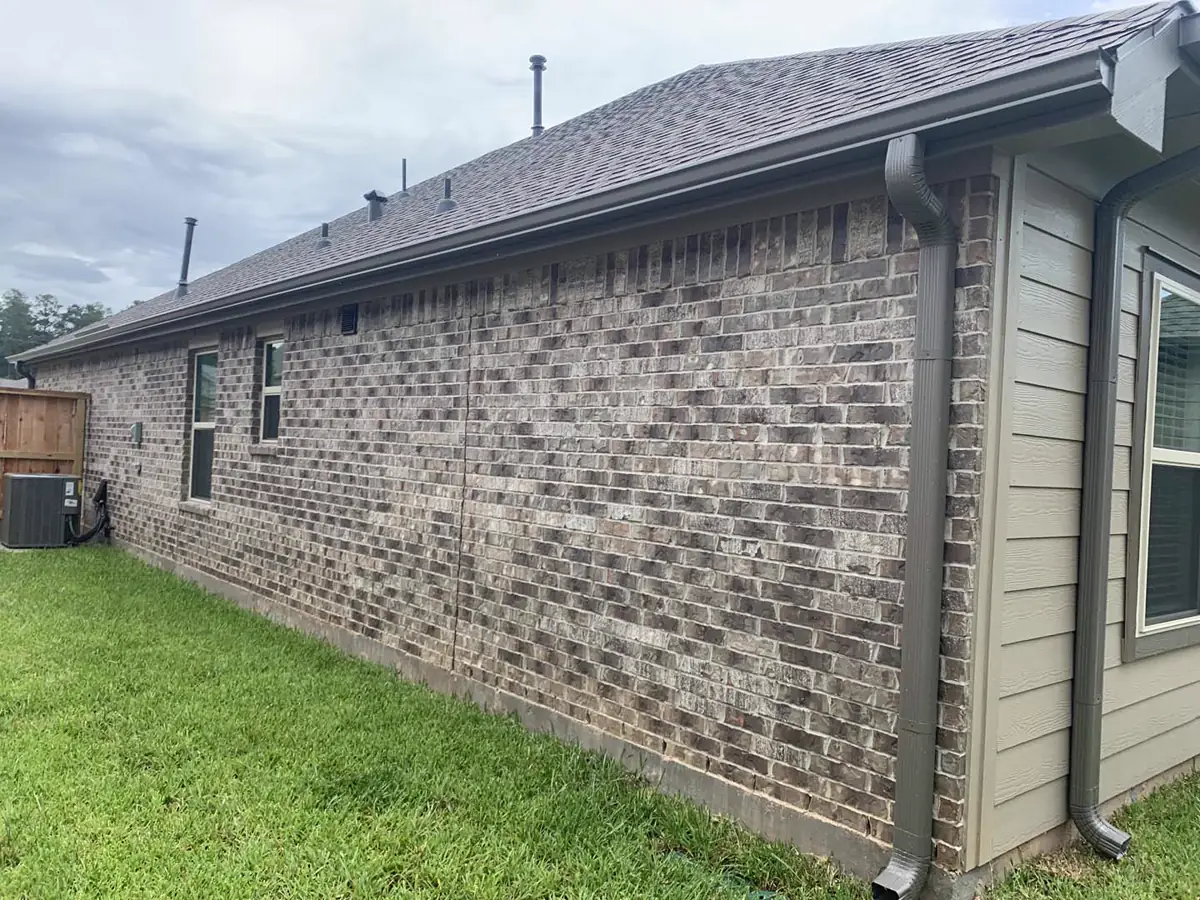
Mac's usual residential recommendation is a 6-inch seamless aluminum gutter with 3-by-4 downspouts. It fits the scale of many local homes, provides useful capacity for hard Texas rain, and gives him more room to manage slope without making the finished roofline look awkward.
“Put some Crocs on and go outside while it's raining. Watch where the roof water lands, where it collects, and which way the ground carries it.”
Mac on understanding the real water problem
Why Mac usually recommends 6-inch gutters
A bigger gutter is not a substitute for good layout, but a 6-inch system is Mac's practical starting point for most homes around Conroe, Montgomery, and The Woodlands. The roof area, pitch, valleys, long runs, and outlet locations still determine the final plan. Five-inch gutter remains available when the house or customer calls for it, while 7-inch and specialty profiles are generally considered for commercial or unusual work.
| Option | Where it tends to fit | Mac's practical view |
|---|---|---|
| 5-inch | Smaller or specifically requested systems | Available, but not his normal recommendation for local residential work |
| 6-inch | Most residential installations | Usual recommendation with 3-by-4 downspouts |
| 7-inch | Commercial or unusually demanding rooflines | Quoted case by case |
Seamless does not mean seam-free
Mac forms each straight run from aluminum coil at the property, so there are no unnecessary joints along that measured length. Corners, end caps, outlets, and downspout connections still have to be fitted and sealed. Care at those connection points is part of a sound installation.
The estimate starts with what you are trying to accomplish
Some homeowners are stopping water over a doorway. Others are protecting flower beds, correcting erosion, replacing a failing system, or trying to make a new addition match the house. Mac asks about the goal first, then reads the roof and the ground together instead of pricing only linear footage.
- Roof area, pitch, valleys, and concentrated runoff
- Long runs, planned slope, outlets, and downspout locations
- Visible fascia condition and existing flashing or drip edge
- Porches, gardens, driveways, low spots, and ground slope
- Material, profile, color, guard choice, and finished appearance
A downspout about every 30 feet is a starting point, not a rule
Mac often begins layout planning with at least one outlet and downspout for roughly every 30 feet of gutter. Valleys, large roof areas, concentrated flow, long runs, and limited discharge options can require closer spacing. The actual roof decides the layout; a generic spacing number does not.
Materials, profiles, colors, and finish
Painted aluminum in a standard K-style profile is the normal residential system. dcGutterPRO buys and builds with American-made gutter products and confirms the exact material included in each estimate. The company also discusses galvalume steel, copper, box gutter, half-round, straight-face, and other specialty work when the property justifies it. Mac brings physical color samples because a phone or monitor cannot show the finish accurately. Product availability and the manufacturer's written warranty are confirmed for the selected material at the estimate.
- Normal residential coil is approximately .027-inch aluminum
- K-style is available in common 5-, 6-, and some 7-inch configurations
- Six-inch half-round and specialty profiles are quoted case by case
- Physical Senox color samples are used for the final selection
- dcGutterPRO provides a one-year workmanship warranty
How installation day works
Mac and Bronte arrive with the gutter machine, protect the work area, remove old material when included, and inspect what is exposed. Mac carefully works with the existing drip edge or flashing, forms the measured runs, completes corners and outlets, installs downspouts, and adds guards last when selected. The job ends with cleanup and a visual walkaround. Real rain—not a garden hose—provides the most meaningful final test of the roof's runoff pattern.
Three estimate levels without a hard sell
Homeowners can compare a basic gutter-and-downspout system, a standard option with Smart Flow aluminum guards, and a premium option with LeafBlaster Pro stainless micro-mesh and concrete splash blocks. Mac explains the tradeoffs and lets the homeowner decide. Exact scope and pricing stay property-specific.
Seamless gutter questions Mac hears from homeowners
Do I need gutters around the entire house?
Not automatically. The answer depends on where roof water is creating risk, the roof geometry, doors and walkways below, landscaping, soil, and the direction the ground slopes. Some homes need a complete system; others can be handled responsibly with selected runs.
Are 6-inch gutters better than 5-inch gutters?
For most of Mac's local residential work, 6-inch gutter with 3-by-4 downspouts is the better starting point. It offers more capacity and usually fits the scale of the fascia well. A smaller system can still be appropriate on the right roof.
Does seamless mean there are no seams anywhere?
No. Each straight run is formed as a continuous piece, but corners, end caps, outlets, and downspout connections still require fitted and sealed joints.
How many downspouts will I need?
Mac often starts at roughly one downspout per 30 feet, then adjusts for roof area, pitch, valleys, concentrated flow, long runs, and the places where water can safely discharge.
Can you match my trim or roof color?
Mac brings physical color samples to the estimate and helps choose a complementary or close-matching finish. Screen colors are only an approximation, so the physical sample is the final reference.
What warranty do you provide?
dcGutterPRO provides a one-year workmanship warranty. Material and paint coverage comes from the selected manufacturer and is reviewed from the current written warranty rather than summarized as an unconditional guarantee.
Can I get a price from linear footage alone?
Not a dependable final price. Height, access, roof geometry, corners, outlets, downspouts, removal, fascia condition, material, guards, and discharge details all affect the written estimate.